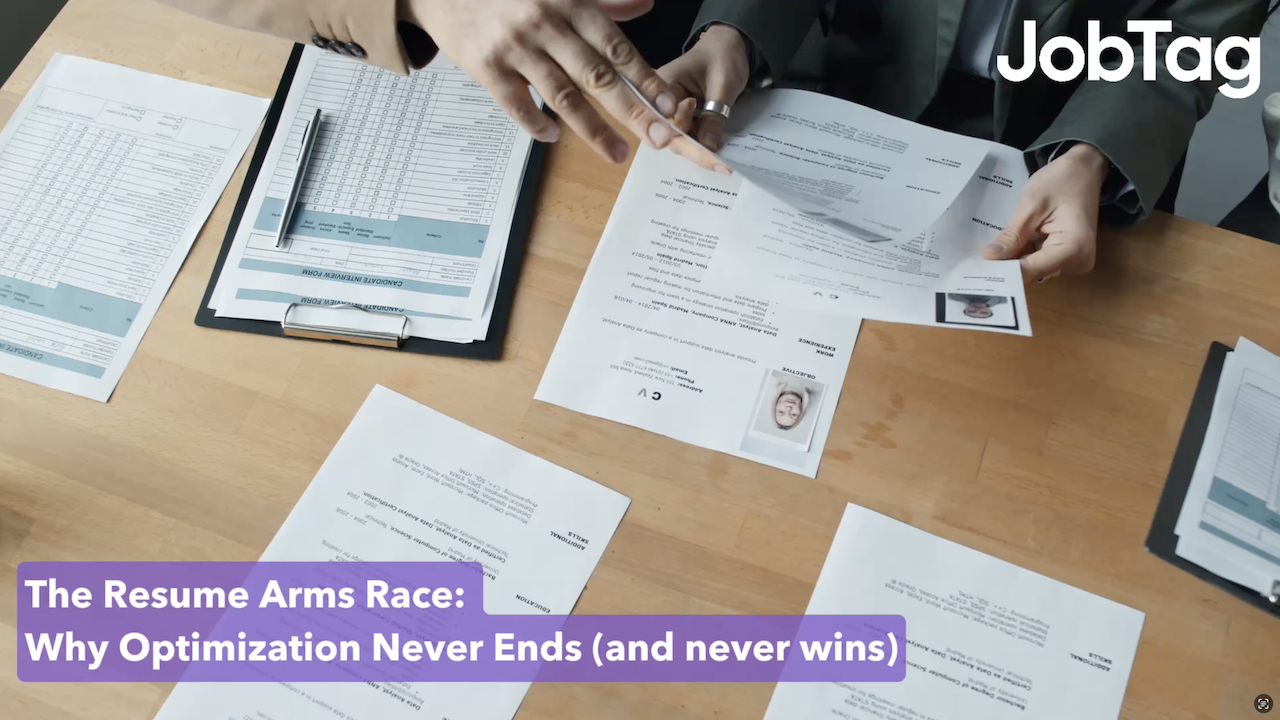

The Resume Arms Race: Why Optimization Never Ends (and Never Wins)
There’s a quiet competition happening in modern hiring.
It’s not visible.
It’s not announced.
But almost every job seeker is part of it.
The resume arms race.
Candidates tweak keywords.
They adjust titles.
They rewrite summaries.
They optimize formatting.
They mirror job descriptions.
And then they do it again.
Because everyone else is doing the same.
WHEN OPTIMIZATION BECOMES THE STRATEGY
Modern hiring systems reward optimization.
Resumes are scanned.
Keywords are matched.
Scores are calculated.
Filters are applied.
So candidates adapt.
They learn how to optimize.
They study templates.
They use AI tools.
They refine wording.
But as optimization becomes more common, something unexpected happens.
Everyone starts to look the same.
THE MORE EVERYONE OPTIMIZES, THE LESS ANYONE STANDS OUT
When everyone uses the same strategies, differentiation disappears.
Similar keywords.
Similar structures.
Similar summaries.
Similar experiences.
The result?
Employers see hundreds of resumes that feel nearly identical.
Candidates spend more time optimizing, but visibility doesn’t improve.
And the cycle continues.
THE ARMS RACE THAT NEVER ENDS
Once optimization becomes the standard, the bar keeps moving.
New keywords emerge.
New formats appear.
New tools promise better results.
Candidates adjust again, but everyone else adjusts too.
Optimization becomes an endless loop.
More effort.
More time.
Same outcome.
And the real signal gets lost.
WHAT GETS LOST IN THE PROCESS
When hiring becomes an optimization game, important things disappear.
Personality.
Communication.
Context.
Potential.
Resumes become polished, but less human.
Candidates become optimized, but less visible.
Hiring becomes slower, not faster.
Ultimately differentiation becomes harder.
THE PROBLEM ISN’T CANDIDATES, IT’S THE SYSTEM
Candidates aren’t optimizing because they want to.
They’re optimizing because they have to.
When systems prioritize keywords, candidates respond with keywords.
When systems prioritize formatting, candidates respond with formatting.
Hiring was never meant to be a technical competition.
It was meant to be a human decision.
A DIFFERENT WAY TO STAND OUT
The strongest differentiation rarely comes from optimization.
It comes from:
Communication.
Presence.
Clarity.
Authenticity
These are the things what matter the most, and unfortunately resumes alone struggle to capture.
WHY THIS MATTERS
The resume arms race creates frustration on both sides.
Candidates spend hours refining documents.
Employers spend hours filtering similar profiles.
Yet meaningful connections happen later, not earlier, and when conversations happen late, hiring slows down.
WHERE JOBTAG FITS
JobTag was built to reduce reliance on optimization.
Video introductions allow candidates to communicate naturally.
Profiles highlight skills and personality.
Conversations happen earlier in the process.
Instead of optimizing endlessly, candidates can focus on being understood.
Instead of filtering endlessly, employers can focus on meaningful signals.
LOOKING FORWARD
The future of hiring won’t be defined by who optimizes best.
It will be defined by who connects best.
Hiring isn’t a technical competition, it’s a human one.
The resume arms race never ends.
But better hiring means stepping out of it entirely.
IF YOU'RE READY FOR BETTER
Explore JobTag - hiring built for humans, not systems.
Morgan
Morgan Hale writes about the future of hiring, human-centered design, and the real challenges people face in today’s job market. With a background in HR technology and workforce psychology, Morgan focuses on exposing outdated hiring practices and highlighting solutions that restore dignity and transparency to the job world.
Leave a Reply