

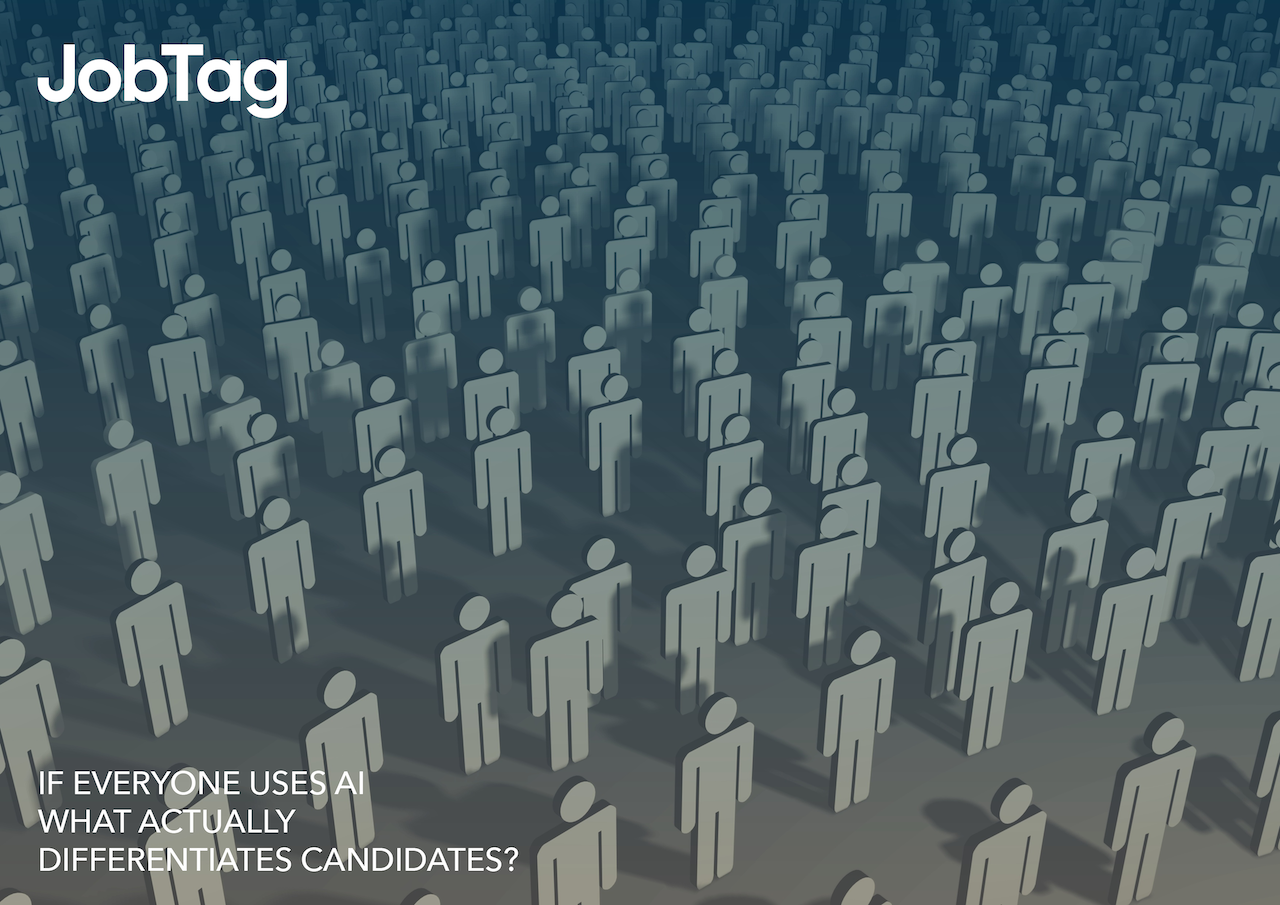
If Everyone Uses AI, What Actually Differentiates Candidates?
THE NEW ADVICE EVERYONE IS HEARING
"Learn AI".
It’s quickly becoming the default career advice.
Learn the tools.
Prompt better.
Automate your workflow.
Use AI to write, analyze, design, code, summarize, organize.
Every week there seems to be a new guide explaining how to stay competitive in the age of artificial intelligence. New tutorials appear daily. New tools appear even faster. Entire newsletters and communities are dedicated to helping people become “AI fluent.”
And for many people navigating the job market, the message is clear: if you don’t learn these tools, you risk falling behind.
But beneath that advice lies a quieter question that few people stop to ask.
If everyone is using the same AI tools... what actually makes someone stand out?
WHEN TOOLS BECOME THE BASELINE
Technology has always followed a familiar pattern.
In the beginning, a new tool creates advantage. The early adopters move faster, experiment more, and appear almost magical to everyone else.
Eventually the tool spreads. More people learn it. More companies adopt it. Tutorials multiply. Courses appear. The technology becomes part of the standard toolkit.
What once differentiated people slowly becomes ordinary.
The internet followed this path. So did spreadsheets. So did smartphones.
At first, those who understood them had a visible edge. Later, they simply became part of everyday work.
Artificial intelligence appears to be moving along the same trajectory.
Today, people across industries are experimenting with AI tools to draft emails, explore data, write code, structure ideas, or accelerate research. The novelty is still fresh, but the direction is already visible.
AI is not remaining a niche skill. It is becoming infrastructure,
and when a tool becomes infrastructure, something interesting happens: the advantage shifts away from the tool itself.
THE ILLUSION OF THE TOOL ADVANTAGE
It is tempting to believe that mastering AI tools will be enough to stand out, but tools rarely create lasting differentiation on their own.
Two people can sit in front of the same AI system and produce completely different results.
One might generate something shallow, generic, or disconnected from the real problem. The other might extract insight, structure thinking, and arrive at something genuinely useful.
The difference rarely lies in the tool. It lies in the person using it.
AI can generate outputs, but it cannot decide which direction is meaningful. It cannot fully understand context. It cannot sense nuance in a conversation or detect the emotional tone of a team discussion. It cannot recognize when an answer feels technically correct but strategically wrong.
Those decisions remain human.
In that sense, AI does not replace human capability. It amplifies it.
Which means the qualities that matter most are the ones that existed long before AI appeared.
THE HUMAN SIGNALS THAT MATTERS
When tools become universal, differentiation returns to what technology cannot easily replicate.
Judgment becomes more important than output. The ability to decide which path actually solves a problem becomes far more valuable than the ability to generate possibilities.
Context becomes critical. Understanding the subtleties of an industry, the relationships within a company, or the emotional dynamics of a team requires lived experience that machines do not possess.
Communication also becomes more valuable, not less. Ideas still need to be explained, decisions defended, and groups aligned. AI can help draft words, but it cannot replace the human instinct that senses when a message resonates or when a room grows uncertain.
And then there is presence. The subtle but powerful signals people transmit when they speak, listen, question, and respond. Confidence, curiosity, humility, clarity. These qualities appear immediately in human interaction, yet they remain invisible in most traditional hiring systems.
Ironically, the more advanced technology becomes, the more these human qualities begin to stand out.
THE HIRING PARADOX
Yet modern hiring systems often struggle to recognize those signals.
Many hiring journeys still begin with automated filters, resume parsing systems, and keyword matching. Candidates are screened based on formatting, titles, and lists of skills long before any conversation takes place.
These systems were designed to manage scale. Companies receive large numbers of applications, and automation helps reduce the workload.
But the side effect is a quiet paradox.
The qualities employers say they value most - judgment, adaptability, communication, leadership - are often the hardest qualities to detect through automated screening.
What gets filtered first are documents.
What actually determines success in the role is often something deeper.
WHEN EVERY RESUME LOOKS PERFECT
Artificial intelligence is already influencing how candidates prepare applications.
Resumes are optimized. Cover letters are generated instantly. Language becomes polished and consistent.
At first glance, this might seem like progress, but it introduces a new challenge.
When tools help everyone produce well-written applications, the documents themselves begin to look remarkably similar:
Polished. Structured. Keyword-aligned, yet strangely indistinguishable.
If every resume appears perfect, it becomes harder to understand who the person actually is.
The signal fades, and hiring systems that rely primarily on documents begin to lose their ability to differentiate candidates meaningfully.
RETURNING TO HUMAN SIGNALS
This is where hiring begins to change.
When documents stop revealing enough information, employers start looking for signals that cannot easily be standardized.
They pay closer attention to how people communicate, how they explain ideas, how they respond to unexpected questions, how they think through ambiguity.
These moments reveal far more about a person’s potential than perfectly arranged paragraphs ever could, and they only appear through interaction, not through optimization.
A DIFFERENT WAY FORWARD
If artificial intelligence becomes universal, hiring systems will inevitably evolve.
The question is not whether AI will change work. It already has.
The question is whether hiring systems will continue to rely on signals that become weaker as technology improves or whether they will shift toward signals that remain uniquely human.
Signals like presence. Communication. Judgment. Curiosity. Adaptability.
These are the qualities that determine how people actually perform in real environments, yet they remain difficult to capture through static documents.
HOW JOBTAG FITS INTO THIS FUTURE
JobTag was built around a simple observation: the most meaningful signals about people rarely appear in resumes alone.
That is why JobTag emphasizes human visibility earlier in the hiring process.
Through video-first profiles, candidates can introduce themselves in a way that communicates far more than text alone. Employers are able to observe communication style, clarity of thought, and presence immediately.
Instead of waiting for weeks of filtering and document review, discovery can happen in real time. Conversations begin earlier, and decisions are informed by interaction rather than guesswork.
The goal is not to replace resumes entirely. Documents still have their place.
But hiring should not rely exclusively on documents to understand people.
Because people are far more complex than that.
THE REAL DIFFERENTIATOR
Artificial intelligence will continue to reshape how work is done, but it will not erase what makes people valuable.
If anything, it will make those human qualities more visible.
The real differentiator will never be the tool alone.
It will always be the person behind it, and the hiring systems of the future will recognize that difference.
IF YOU'RE READY FOR BETTER
Explore JobTag - hiring built for humans, not systems.


Morgan
Morgan Hale writes about the future of hiring, human-centered design, and the real challenges people face in today’s job market. With a background in HR technology and workforce psychology, Morgan focuses on exposing outdated hiring practices and highlighting solutions that restore dignity and transparency to the job world.
Related posts
The Resume Arms Race: Why Optimization Never Ends (and Never Wins)
Leave a Reply